
Stratonikeia
A place at Eskihisar where ancient city and village fabric stand together from the Late Bronze Age to the Republic.
 Photograph unavailable
Muğla · Carian city
From gladiators to an Ottoman village
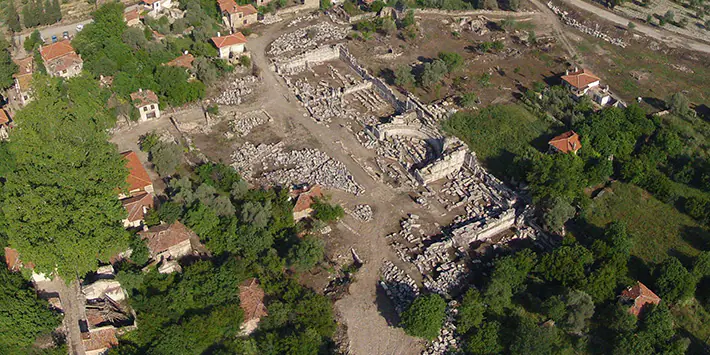
One of the ancient world's largest marble-built cities, Stratonikeia weaves Hellenistic council halls, Roman baths and gladiator tombs directly alongside the red-tiled structures of Eskihisar village.
Market and assembly along paved streets
Monumental colonnaded avenues, public fountains and civic inscriptions detailing ancient calendars and commodity prices carved into council walls bring classical municipal life to life.
From ancient street to Ottoman house
Seljuk baths, the 19th-century Şaban Ağa Mosque, wooden tea-houses and towering plane trees merge organically with antique columns into a living time capsule.
Gateway to the Sacred Way of Hekate
The stone-paved Sacred Way leads directly from Stratonikeia to the mystical sanctuary of Hecate at Lagina, connecting seamlessly with Milas and Beçin.
City of eternal love and gladiators
Lying in Eskihisar village near Yatağan, Stratonikeia offers a fascinating blend of Hellenistic monuments, Roman gladiator stelae and traditional Ottoman timber houses. Linked via the ancient Sacred Way to Lagina, and nearby Knidos and Milas, it forms an extraordinary cultural crossroads.
Layers of the place
How is the place situated?
The Hellenistic grid, Roman civic buildings and the red-tiled structures of Eskihisar can be seen within the same area. Their proximity does not give every structure the same date or function. Stratonikeia and Lagina are also separate centres linked historically by a Sacred Way.
How do the layers change?
The official source distinguishes Late Bronze Age traces; the names Atriya, Chrysaoris, Idrias, Stratonikeia and Eskihisar; and fabric from Hellenistic, Roman, Byzantine, beylik, Ottoman and Republican periods. A long settlement sequence does not establish an unchanging population or continuous civic institutions.
How was the place inhabited?
The gymnasium, theatre, bouleuterion, baths, agora, temple, gate and colonnaded street represent different settings of urban movement and public life. The Calendar of Menippos and a Roman price inscription make public systems of time and economic regulation visible, while the source does not reproduce every text or explain its reception in every period.
What can be said today?
Stratonikeia can be read today through ancient structures, excavation areas, tree cover and the buildings of Eskihisar together. This creates a strong layered-city experience; current excavation access, hours, tickets and conservation conditions still require dated official confirmation.
Connected stops
Stories that include this stop
Sources
Frequently asked questions
Where is Stratonikeia?
Stratonikeia is presented in this guide as a carian city in Muğla.
How can I find sources for Stratonikeia?
The Sources section links to the evidence supporting this dossier.