
Knidos
Caria's open-sea city at the tip of Datça, shaped by twin harbours, terraces and maritime trade.
 Photograph unavailable
Muğla · Peninsula harbour
Two harbours opening to two seas
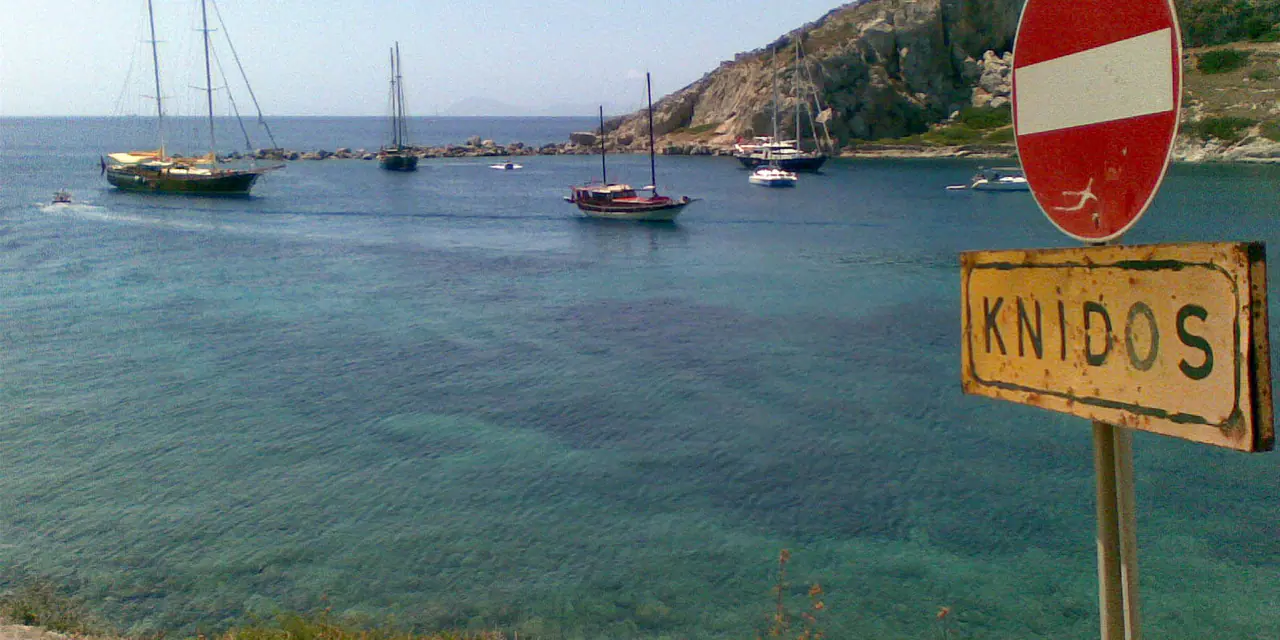
Poised at the dramatic western tip of the Datça Peninsula where the Aegean meets the Mediterranean, Knidos commanded ancient shipping lanes with twin harbours shielding both naval and trading fleets.
A city built in terraces
Rising in majestic stone terraces above the sea, this terraced city adapted to mountainous ground celebrated art and astronomy, famous for Praxiteles's Knidian Aphrodite and Sostratus's architecture.
Wine, olives and maritime trade
Knidian stamped wine amphorae travelled to ports across the classical Mediterranean, carrying the bounty of its vineyards alongside the groundbreaking astronomical discoveries of Eudoxus.
Sunset where two seas meet
Watching sunset from the Cape Krio lighthouse where the two seas converge crowns any journey through Halicarnassus and Stratonikeia.
Where the Aegean meets the Mediterranean
Crowning the furthest tip of the Datça Peninsula where the Aegean and Mediterranean embrace, Knidos captivates with twin natural harbours, a sea-facing amphitheatre and the legendary sanctuary of Aphrodite. Neighbouring Halicarnassus, Stratonikeia and Kaunos, it remains an eternal monument to Carian seafaring.
Layers of the place
How is the place situated?
The official source describes Knidos as a terraced city adapted to mountainous ground and rising from the coast toward the acropolis like a theatre. Joining Kap Krio to the mainland created western and eastern coves with distinct harbour functions; the harbours, island section and mainland are separate spatial focuses.
How do the layers change?
The source distinguishes the city's importance from the 6th century BCE, Hellenistic and Roman urban structures, and later churches and reuse. Recent research rejecting the identification of the Round Temple Terrace with Aphrodite clearly shows how interpretation can change with new evidence.
How was the place inhabited?
Wine production and export, shops, workshops, a stoa and two harbours reveal different settings for production, exchange and maritime movement. The source does not provide trade volumes, ship counts or an uninterrupted sequence in which every workshop operated at the same time.
What can be said today?
Knidos should be read today through its two harbours, urban terraces and changing interpretations of buildings. Current road or sea access, tickets, hours, excavation and conservation conditions must be checked separately through dated official channels.
Connected stops
Stories that include this stop
Sources
Frequently asked questions
Where is Knidos?
Knidos is presented in this guide as a peninsula harbour in Muğla.
How can I find sources for Knidos?
The Sources section links to the evidence supporting this dossier.