
Tralleis
On the plateau north of Aydın: Tralleis, carrying production, learning, music and urban life together.
 Photograph unavailable
Aydın · Hillside city
The southern face of the Kestane Mountains
Tralleis stands on a high plateau on the southern slope of the Kestane Mountains overlooking the fertile valley of the Büyük Menderes, commanding natural crossroads.
Sculptors and red-gloss ceramics
Renowned for its master sculptors Apollonios and Tauriskos—famed creators of the Farnese Bull—Tralleis also exported fine red terra sigillata ceramics across the ancient Mediterranean.
Seikilos's song on stone
The Seikilos inscription preserves a song's words alongside the symbols recording its melody. Now in the National Museum of Denmark, this small text invites us to approach ancient music through sound as well as written names. Older fragments of notated music also survive; here, the words and melody can be read together.
Three Eyes and the ancient gymnasium
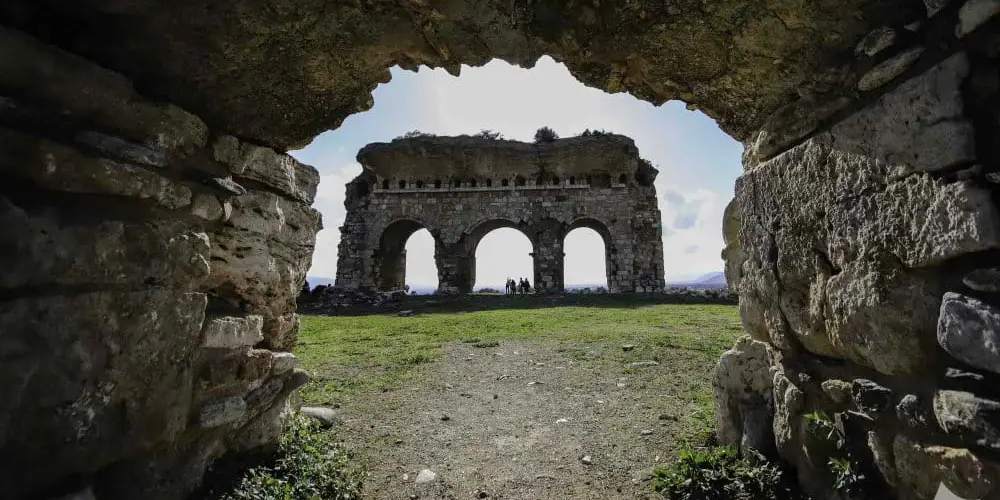
The towering arches known locally as Üç Gözler (Three Eyes) belong to a grand Roman gymnasium, forming a magnificent gateway to Nysa, Mastaura and Aphrodisias.
A song preserved on stone
Overlooking modern Aydın from its terrace plateau, Tralleis is famous for the monumental brick arches of Üç Gözler, a renowned Roman sculpting school and the cultural memory of the Seikilos inscription. Neighbouring Nysa, Mastaura and Aphrodisias, it embodies the musical and architectural brilliance of classical Asia Minor.
Layers of the place
How is the place situated?
The official source places Tralleis on a plateau on the southern slope of the Kestane Mountains, within the fertile Maeander basin. Üç Gözler, the baths, theatre, agora and stadium are distinct parts of the civic layout on that plateau.
How do the layers change?
Üç Gözler is identified as the surviving part of a gymnasium built in the 2nd century CE. Because the source does not assign all the other civic buildings to the same date, the history of Tralleis should not be reduced to a single Roman monument.
How was the place inhabited?
A gymnasium, baths, theatre, agora and stadium suggest different public settings for training, bodily culture, assembly, exchange and performance. These functions can be read from the building types, while the source does not provide individual life stories or daily schedules.
What can be said today?
Üç Gözler is the most immediately recognisable architectural focus of Tralleis today, but the city is more than its three arches. Current access, hours, excavation and conservation conditions may change and should be checked through official channels before a visit.
Connected stops
Stories that include this stop
Sources
Frequently asked questions
Where is Tralleis?
Tralleis is presented in this guide as a hillside city in Aydın.
How can I find sources for Tralleis?
The Sources section links to the evidence supporting this dossier.