
Nysa
Celebrated for its library and gorge-spanning bridges at Sultanhisar, Nysa was ancient Caria's great city of letters.
 Photograph unavailable
Aydın · Valley and bridge city
Bridging the great ravine
Set against the southern slopes of the Messogis range, Nysa was developed on both sides of a deep gorge carved by a mountain torrent. Roman civil engineers bridged this precipitous ravine with three stone viaducts and a massive vaulted culvert beneath the stadium, unifying both halves of the city.
Anatolia's second great library
Dating to the second century CE, the two-storey Library of Nysa survives as Anatolia's best-preserved classical library after Ephesus's Celsus. Here the geographer Strabo studied literature and rhetoric, confirming Nysa's renown as an acclaimed centre of philosophy and medicine in the Roman Empire.
A theatre crowned with Dionysiac reliefs
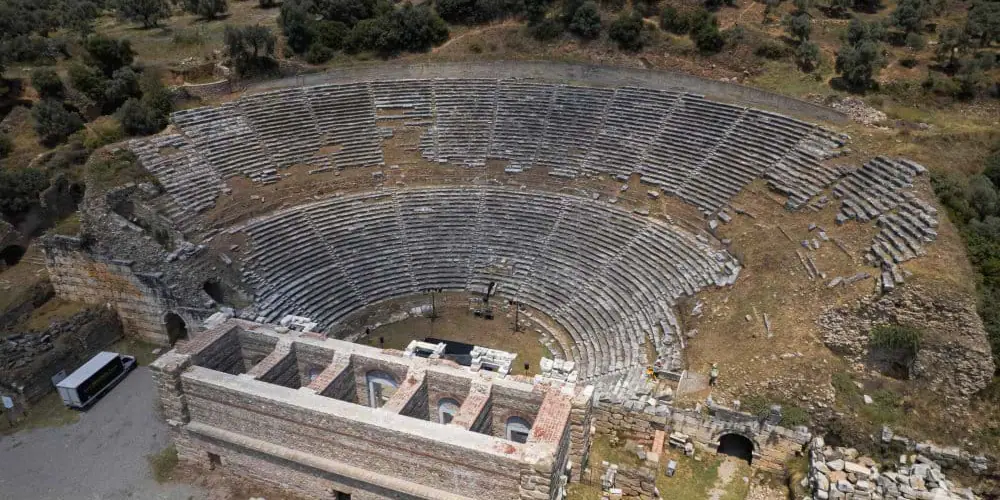
Accommodating 12,000 spectators against the natural slope, Nysa's theatre boasts exquisite friezes depicting the mythological life and rites of Dionysus. Across the gorge, the impeccably preserved Bouleuterion and colonnaded agora mirror the city's civic and artistic vitality.
A valley of knowledge among ancient olives
Sheltered by ancient olive trees and fragrant wild oregano, Nysa invites travellers to wander paved Roman avenues in contemplative peace. It forms a peerless cultural waypoint along the Maeander valley between Tralleis and Aphrodisias.
Capital of learning in the Maeander valley
With its gorge-spanning Roman bridges, two-storey library where Strabo studied and radiant Dionysiac theatre, Nysa stands as the Maeander valley's foremost sanctuary of letters, art and hydraulic architecture.
Layers of the place
How is the place situated?
Nysa developed on both sides of a deep gorge, whose two halves were connected by three bridges according to the official record. A gymnasium, stadium, theatre, agora, bouleuterion, baths, library and Byzantine structure reveal civic spaces organised around the gorge rather than on one flat plane.
How do the layers change?
The source presents Hellenistic, Roman and Eastern Roman layers at Nysa, but does not date every structure to one moment or one building programme. Bridges, performance buildings, educational settings and the Byzantine trace should therefore be read as successive uses of the city.
How was the place inhabited?
Nysa's reputation for education and Strabo's study there allow the library and other civic buildings to be read as places of knowledge exchange as well as architecture. The source does not provide the size of the educational community or a complete catalogue of instruction.
What can be said today?
The relationship between gorge, bridges and civic buildings remains the main key to reading Nysa. Because the official record does not continuously guarantee current tickets, hours, field access or conservation conditions, visitor information must be checked separately.
Connected stops
Stories that include this stop
Sources
Frequently asked questions
Where is Nysa?
Nysa is presented in this guide as a valley and bridge city in Aydın.
How can I find sources for Nysa?
The Sources section links to the evidence supporting this dossier.