
Euromos
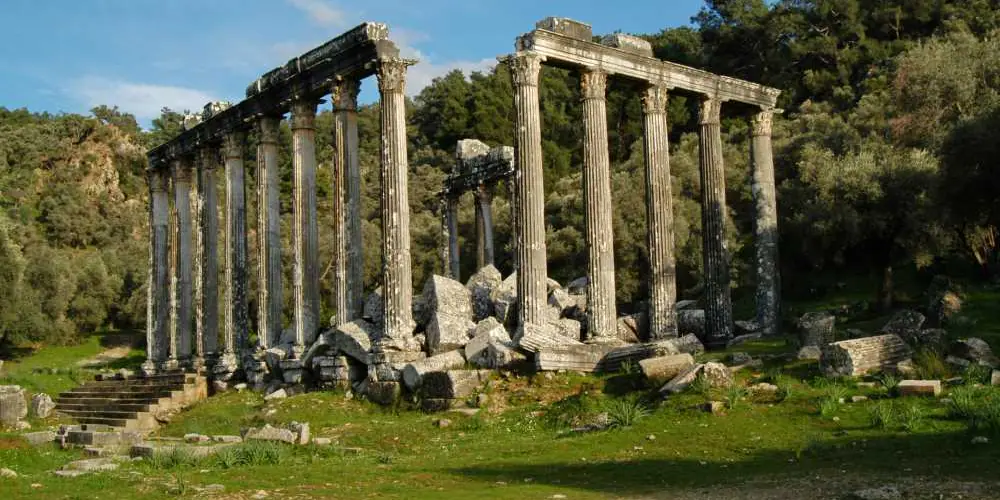
Hidden among silvery olive groves on the road to Milas, Euromos preserves one of Asia's most intact Corinthian sanctuaries, the Temple of Zeus Lepsynos.
 Photograph unavailable
Muğla · City of an inscribed temple
A Carian city on the Kızılbayır foothills
Euromos spreads gracefully across the olive-covered slopes of Mount Kızılbayır near Selimiye. As a vital pillar in the historical urban network around Mylasa, the city controlled both fertile plains and crucial mountain transit routes through inland Caria.
The Corinthian colonnade of Zeus Lepsynos
With sixteen Corinthian columns standing proudly beneath the Aegean sky, the 2nd-century CE Temple of Zeus Lepsynos ranks among Asia Minor's best-preserved classical shrines. Votive tablets carved into column flutes record the generous benefactions of local citizens who funded the monument.
Theatre, agora and ancient groves
Nestled into the terraced hill, a secluded Hellenistic theatre, an agora flanked by colonnaded stoas and rock tombs attest to a vibrant civic community. An unearthed inscription recounting a border dispute resolved with nearby Herakleia reveals sophisticated inter-city arbitration.
An ancient monument amidst quiet groves
Bathed in birdsong and the rustling of olive leaves away from tour buses, Euromos offers intimate encounters with classical grandeur. It forms an indispensable, poetic waypoint between Herakleia Latmos and Labraunda.
A sanctuary city guarded by olives
With its sixteen Corinthian columns rising gracefully from olive groves, hillside theatre and citizen dedications, Euromos is Caria's most poetic sanctuary town along the highway connecting Milas and Herakleia.
Layers of the place
How is the place situated?
The official record places Euromos within the historical urban network around Mylasa. Its most visible architectural focus today is the standing colonnade of the Temple of Zeus, but the temple should not be treated as the whole urban site; other remains need separate spatial nodes.
How do the layers change?
The source distinguishes the name Kyramos or Hyramos, recorded in the 5th century BCE, from the later name Euromos. It dates the Corinthian Temple of Zeus to the 2nd century CE; unfluted columns indicate that construction and decoration were not completed uniformly across the building.
How was the place inhabited?
An inscription-based dispute in the record describes an intervention in Euromian territory by Heracleans and an envoy sent by the authorities of Mylasa. It reveals a context of property, sacred goods and mediation between cities, not continuous hostility across every period.
What can be said today?
Euromos is read today especially through the standing columns of the Temple of Zeus. Because the official page does not provide a current restoration schedule, tickets, hours or field conditions, visiting information must be checked separately through dated institutional notices.
Connected stops
Stories that include this stop
Sources
Frequently asked questions
Where is Euromos?
Euromos is presented in this guide as a city of an inscribed temple in Muğla.
How can I find sources for Euromos?
The Sources section links to the evidence supporting this dossier.