
Antandros
On Mount Ida's southern foot: an ancient settlement where the Edremit Gulf meets mountain passages, carrying the everyday traces of a necropolis and Roman villa.
 Photograph unavailable
Balıkesir · Ancient city at the foot of Mount Ida
Between mountain and gulf
Antandros crowns the summit and western slopes of Kaletaşı Hill near Altınoluk, commanding maritime routes along the Edremit Gulf and timber trade from Kaz Dağları.
Everyday life carried by objects
Grave goods from the vast hillside necropolis—terracotta figurines, gold jewellery and fine pottery—exhibit the sophisticated lifestyle and trading connections of the ancient settlement.
Mosaics of the Roman villa
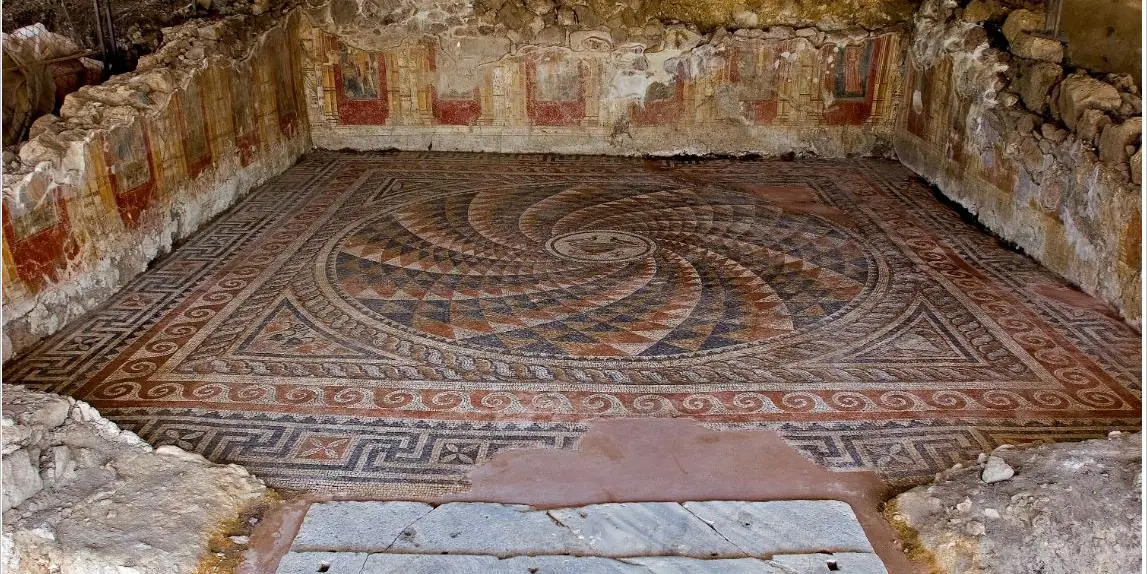
Terraced onto the hillside, an imperial Roman villa preserves spectacular geometric floor mosaics and painted wall frescoes overlooking the azure gulf below.
Shore where Aeneas built his fleet
Virgil's Aeneid recounts that Aeneas built his fleet of twenty ships at Antandros using Mount Ida timber before setting sail to found Rome, linking the town forever to Assos and Troy.
A Roman villa at the foot of Mount Ida
Gazing over the sparkling waters of the Edremit Gulf, Antandros features an exceptional Roman terrace villa adorned with polychrome mosaics alongside an extensive ancient cemetery. Flanked by Kaz Dağları, Assos and Alexandria Troas, it remains steeped in Homeric and Virgilian myth.
Layers of the place
How is the place situated?
The city occupies the summit and western slopes of Kaletaşı Hill, which falls steeply toward the sea north of the Gulf of Edremit. Its position between mountain foot, road and coast is associated with military and strategic importance, but no single remain defines the settlement in full.
How do the layers change?
The official source presents a 10th-century BCE foundation as an assessment rather than a fixed date; the possibility of earlier settlement is also comparative conjecture. Within the material record, the necropolis is associated with the 7th to 2nd centuries BCE and the villa with preserved mosaics and frescoes with the 1st century CE.
How was the place inhabited?
Grave goods from the necropolis make burial practice visible, while the villa's floor mosaic and wall frescoes show decorative work inside a residence. Together they allow Antandros to be read not only as a route or defensive point but as a settlement carrying traces of death and domestic life.
What can be said today?
Some finds from the necropolis are displayed at Bandırma Museum, while the villa and necropolis remain separate archaeological focuses on the ground. Because the official page does not provide current tickets, hours or an excavation route, visiting conditions must be checked through dated institutional notices.
Connected stops
Stories that include this stop
Sources
Frequently asked questions
Where is Antandros?
Antandros is presented in this guide as a ancient city at the foot of mount ida in Balıkesir.
How can I find sources for Antandros?
The Sources section links to the evidence supporting this dossier.