
Alexandria Troas
A major harbour city linking the Troas plain to Roman maritime networks as the shoreline changed.
 Photograph unavailable
Çanakkale · Ancient harbour
An Alexandrian name, a Troas ground
Founded by Alexander the Great's general Antigonus and expanded in Roman times, the city commanded the strategic coastline between Troy and Assos.
Life around the harbour
The colossal Baths of Herodes Atticus, monumental aqueducts and ancient artificial harbour basin bring to life a bustling Mediterranean crossroads of merchants, sailors and travellers.
As the shoreline changed
Once considered by Roman emperors as a potential imperial capital, this harbour city grew quiet as the coastline shifted, yet remains awe-inspiring amid ancient oak forests.
A city spread across open ground
Arches and pink granite columns dispersed across the wide plain whisper the millennium-long bond between sea and fertile land on the Troas coast.
Rome's grand gateway to the Aegean
Alexandria Troas served as one of antiquity's busiest maritime gateways between Rome and Anatolia. Though the shoreline altered over centuries, monumental bath arches and ancient roadways linking toward Troy and Assos attest to its imperial grandeur.
Layers of the place
How is the place situated?
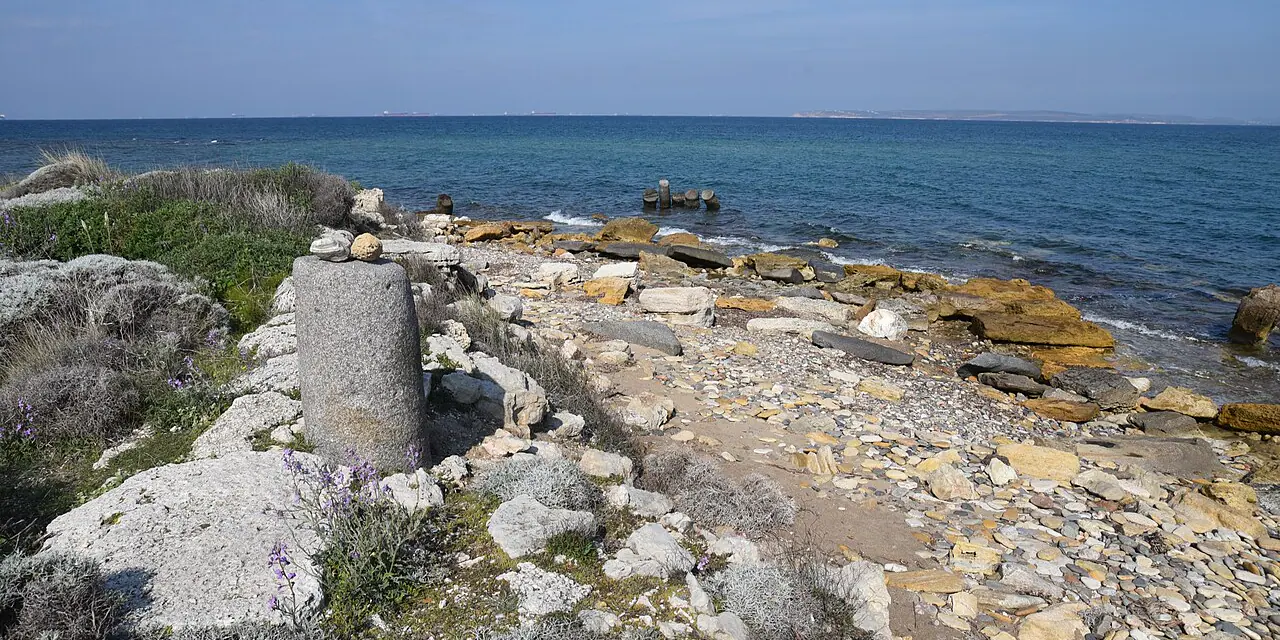
Alexandria Troas occupied a broad coastal plateau that descended westward toward the Aegean, with the large harbour northwest of the inhabited city. Münster's survey describes an outer harbour protected by northern and southern breakwaters, a 36-metre-wide entrance and a long rectangular inner basin. The coordinate attached to this dossier marks the approximate area of the harbour photograph, not the centre of the entire ancient city.
How do the layers change?
The visible remains do not belong to a single moment. The project dates the foundation of Antigoneia to shortly after 310 BCE and its renaming as Alexandria Troas to 301/300 BCE, while noting uncertainty over whether this was a wholly new foundation. Roman public buildings, Hadrianic water infrastructure, Late Antique repairs and modern excavation and conservation form separate chronological layers.
How was the place inhabited?
The harbour functioned as a place where goods changed hands, travellers embarked and disembarked, and customs and port income entered the urban economy. Behind that maritime edge, the forum, agora, Odeion, granite-paved street, baths and waterworks reveal spaces of gathering, representation and everyday civic life. Traditions concerning Paul's visits add a later layer of travel and religious memory without defining the whole city.
What can be said today?
The report on the 2024 season, published in 2026, records excavation in the forum and agora sectors together with architectural documentation, mapping, restoration, conservation, zooarchaeological work and artefact study. This dated evidence establishes an active research and conservation context for that season; it does not provide current opening hours, ticket information or guaranteed site access after the reporting period.
Connected stops
Stories that include this stop
Sources
Frequently asked questions
Where is Alexandria Troas?
Alexandria Troas is presented in this guide as a ancient harbour in Çanakkale.
How can I find sources for Alexandria Troas?
The Sources section links to the evidence supporting this dossier.